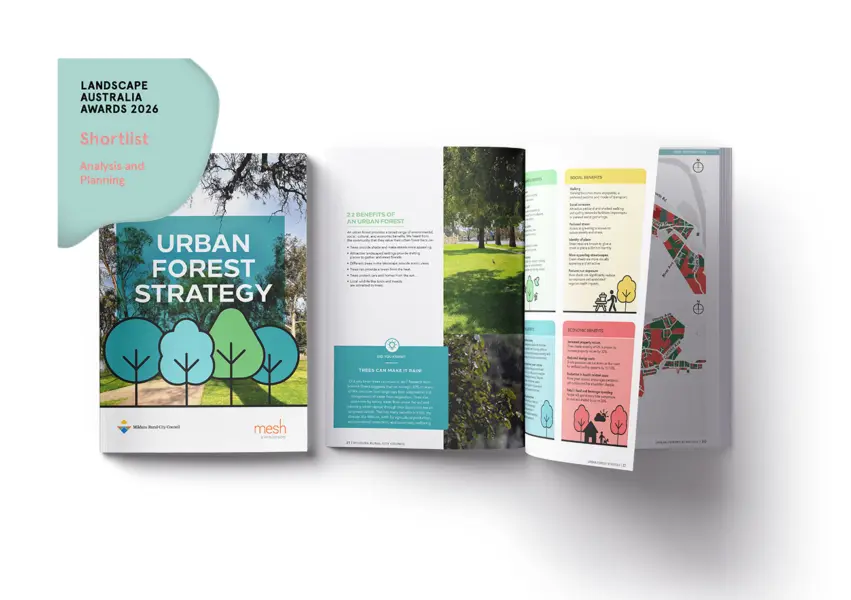


Urban Forest Strategy
The Mildura Urban Forest Strategy is an evidence-led framework for cooler, greener and more resilient places across Mildura, Irymple, Merbein and Red Cliffs. The strategy treats trees as essential civic infrastructure and as a nature-based way to tackle urban heat, public health, biodiversity loss, stormwater and liveability.
It works both as a policy framework and as an implementation tool, a good example of Veris' work with councils on open space that is liveable, equitable and suited to its local setting. The project was completed in collaboration with Council, Rain Consulting, Homewood Consulting and XMAP.
The Challenge
Mildura has a hot, dry climate with long summers, unreliable rainfall and a floodplain setting along the Murray and Darling-Barka Rivers. These conditions make climate pressures on the city worse. XMAP’s thermal mapping recorded surface temperatures of up to 65°C in some urban areas, and shaded streets were always cooler than unshaded ones. Canopy cover is well below the best-practice target of 30%. It is especially low in newer subdivisions, which leaves access to shade uneven across the community. The arborist surveys recorded 36,902 street trees and found gaps in the canopy. They also found many trees that will need replacing within a few years, and too many trees of the same species. Overhead powerlines, hard paved streets, limited soil volume and drought all made new planting harder.
The Solution
The strategy overlays the heat mapping with the street tree survey and 7,121 identified planting sites. This shows where high heat, low canopy, uneven tree distribution and space to plant all occur together, so investment goes where it will do the most good.
Four measurable targets support the strategy:
- 30% net canopy cover.
- At least three trees visible within 20 metres of every home. This measure focuses on fair access to shade and what residents see every day, not just canopy area.
- No more than 10% of trees with less than 10 years of useful life left.
- A 10/20/30 species diversity mix, so no single species, genus or family makes up too much of the tree population.
The data becomes practical action:
- Priority planting maps, planting types and tree replacement programs.
- Planning scheme amendments, planting standards and landscape guidelines.
- Water-sensitive design, including passive irrigation, raingardens, porous pavements, structural soils and soil cells.
- Community programs and advocacy across agencies.
The strategy recommends planting at least 1,400 trees a year, so every identified planting site is filled within five years and working with Traditional Custodians in future to recognise culturally significant trees and Country resulting in a practical model for climate-responsive urban forest planning that other councils can implement.
The expected benefits are cooler streets, new habitat, carbon storage, better stormwater management and healthier soils, along with better walkability, outdoor comfort and community wellbeing.