Mallacoota Streetscape Upgrade
Mallacoota is a remote coastal village located in East Gippsland, Victoria. It is renowned for its natural beauty, surrounded by pristine waters and a stunning inlet, as well as its strong sense of community. Gippsland Projects engaged us to develop a streetscape upgrade for Maurice Avenue – the town’s primary activity street – with the goal of improving the public realm for residents, visitors and local traders.
The Challenge
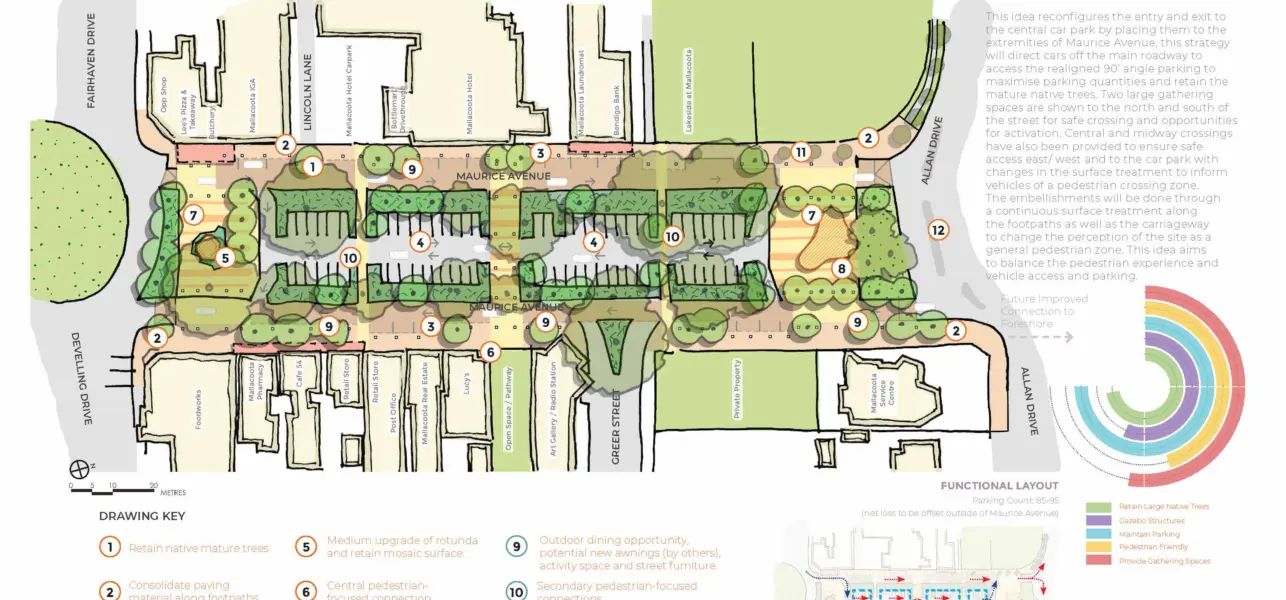
The Mallacoota streetscape presented a complex set of competing priorities within a $1.5 million budget. Balancing the preservation of existing trees, the creation of meaningful gathering spaces, a pedestrian-friendly design, and the retention of car parking were key requirements of the project – while maintaining the village’s distinct coastal and community character.
Another complexity was developing construction estimates amid significant pricing uncertainty. The project spanned the COVID-19 era and its aftermath, a period marked by considerable volatility in construction costs, requiring careful management of design ambition against financial feasibility throughout the process.
The project also demanded genuine community responsiveness. Mallacoota is a close-knit community with a deep sense of place, and the design needed to reflect local values, cultural connections and the community's experience of landscape and recovery – including the ongoing regeneration of bushfire-affected areas.
The Solution
A mid-level masterplan for the Mallacoota streetscape upgrade was developed, grounded in immersive site investigation, structured community engagement and a unifying design concept drawn directly from the landscape and community context.
Site Investigation and Regional Context
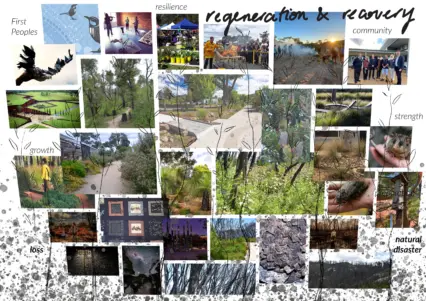
A detailed exploration of Mallacoota and its surrounding region was undertaken, including visits to Quarry Beach and walks along the area’s coastal trails, to develop a first-hand understanding of the landscape’s textures, colours and character. The team also visited areas of the national park affected by the 2019 bushfires, observing the striking contrast between charred remnants and the vivid regeneration emerging from the soils. A visit to the local art gallery – including an encounter with the work of artist Yolande Oakley, which deepened the team’s connection to the region’s cultural and environmental identity, informing the aesthetic direction of the project.
Community Engagement
Two community groups were central to the design process: the Project Control Group (PCG) and the Project Reference Group (PRG). The PRG comprised a diverse representation of local interests, including MADRA, the Mallacoota art gallery and Friends of Mallacoota. Key project milestones were presented to both groups, using these sessions to gather feedback, test design directions and ensure that the needs and aspirations of the local community were genuinely reflected in the evolving masterplan.
Community consultation surfaced a rich set of themes and ideas for the streetscape, including endemic planting, geological influences, freeform landscapes, Aboriginal healing and collaboration, natural materials, immersive landscape experiences and regeneration. These inputs became the foundation for the project’s design concept.
Design Concept: The Mosaic
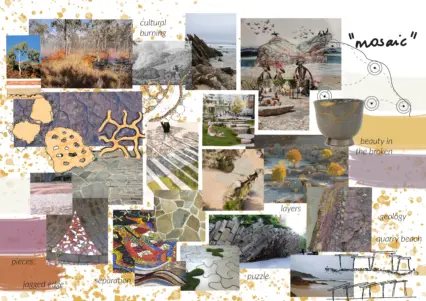
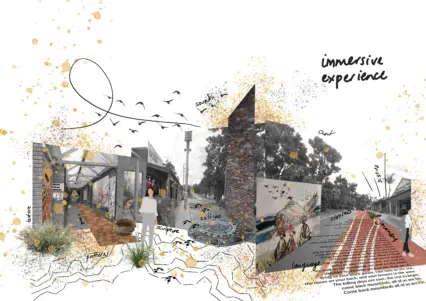
Drawing on community feedback and site investigation, three interwoven design themes were developed: regeneration and recovery, a cultural landscape, and an immersive experience. The unifying concept that emerged to connect these themes was that of a mosaic – a diverse and dynamic composition of elements that together create a coherent whole.
The mosaic concept was inspired by the geological forms and colours of Quarry Beach and became the guiding principle for the ground plane design. It symbolises both a landscape in recovery and the seasonal variation that defines life in Mallacoota, providing a compelling rationale for material, planting and spatial choices throughout the streetscape.
Masterplan and Design Outputs
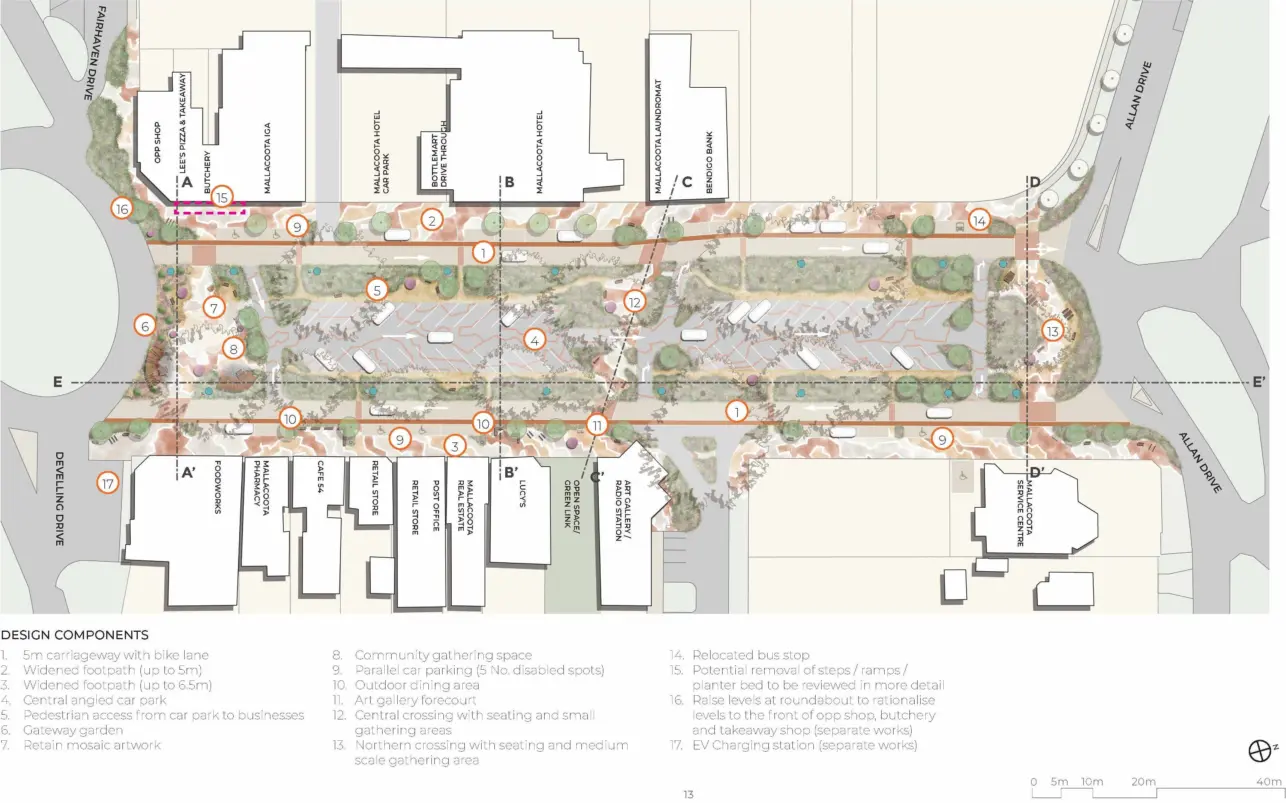
The masterplan provided a detailed layout of the proposed streetscape, including a reconfigured central car park operating as a one-way movement system to reduce pedestrian conflicts and improve safety. Key design drivers embedded throughout included protecting existing valued trees, providing generous and flexible footpath treatments, ensuring ample car parking, and maintaining an overall character that respected Mallacoota’s village scale and coastal setting.
The masterplan was accompanied by a comprehensive report documenting the full design process and providing clear rationale for all design decisions. The mosaic concept was woven throughout both the report and the masterplan drawings, ensuring it functioned as an integrated narrative rather than a decorative add-on.
Outcomes
The Mallacoota Streetscape Upgrade masterplan has delivered a strong foundation for the ongoing development of this distinctive coastal town centre:
- The mid-level masterplan successfully defined the scope and vision for the detailed design phase, directly informing the tendering process for the Detail Design scope of works.
- A design concept rooted in community input and regional landscape character ensures the final streetscape will reflect Mallacoota’s unique identity and the community’s lived experience of the land.
- The reconfigured one-way car park movement system improves pedestrian safety and reduces vehicle-pedestrian conflict along Maurice Avenue.
- The mosaic design framework provides a flexible and scalable language for materials and planting that can be applied consistently across the full streetscape upgrade.