
The Standardisation Dividend: Building Organisational Capability Through Digitalisation
A technical interpretation of the NSW Infrastructure Digitalisation and Data Policy for organisations seeking an enduring, whole-of-lifecycle approach to managing information.
Infrastructure digitalisation policy achieves its greatest value when treated as a standardisation programme rather than a technology implementation. When implemented well, standardisation transforms how information is created, exchanged, and reused, ensuring it remains reliable and reusable throughout the asset lifecycle.
This approach builds organisational resilience. As platforms evolve, standardised information contracts, reference data, and governed exchanges enable continuity, reduce risk, and preserve institutional knowledge. The NSW Infrastructure Digitalisation & Data (IDD) Policy reflects this logic through its mandatory pillars: decision-led information requirements, robust data standards, a Common Data Model, a governed Common Data Environment, procurement integration, and sustained capability uplift.
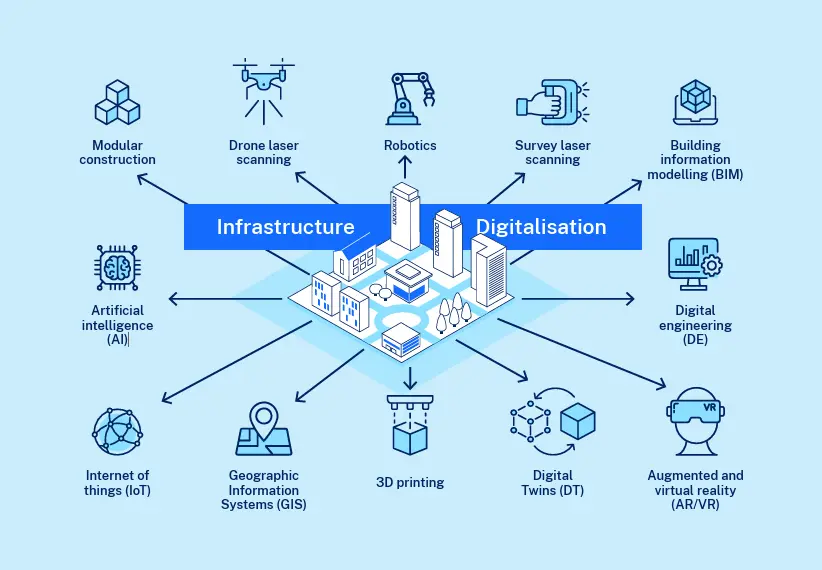
AI represents the next transformative wave in infrastructure operations, but its impact depends on the quality and interoperability of underlying data. Without setting and measuring relevant data standards, even advanced digital tools cannot deliver reliable, scalable results. For organisations seeking to realise the full potential of emerging technologies, standardisation is now both an operational and strategic imperative.

Nick Williams
Digital Capability and Advisory Leader
The Standardisation Dividend: Core Proposition and Implications
Digitalisation is often framed as a question of systems and tools. Policy, however, repeatedly returns to a more durable lever: standardising how information is created, classified, exchanged and assured so it can be trusted and reused across teams and time. Standardisation is not uniformity for its own sake. It is the design of predictable interfaces, semantic, procedural, and contractual, through which information retains meaning as it moves between disciplines and lifecycle phases.
Infrastructure NSW
Data Abundance and the Persistence of Information Friction
Most asset owners already possess extensive data in the forms of design models, geospatial layers, commissioning records, maintenance histories, inspections and performance baselines, all distributed across systems and functions. The constraint is rarely the absence of data; it is the effort required to discover, reconcile and trust it at the point of decision. Where semantics vary by discipline, where information states are unclear, or where exchange criteria are implicit rather than testable, the reuse of information becomes expensive, and cross-team collaboration meets critical limits.
Functional Optimisation and Portfolio-Level Consequences
Asset-intensive organisations have necessarily specialised teams: delivery engineers value for design intent and assurance; operations optimise for maintainability and safety; commercial functions steward contractual risk; finance seeks comparability and cost drivers; geospatial functions steward spatial truth. This plurality is not a weakness; it is a sign of maturity. Underlying each of these, a layer of standardisation can enable composability, providing a basis for each discipline’s information to be combined without translation overhead dominating the work.
A Lifecycle Framework for Information Management and Exchange
ISO 19650 as Reference and Principles
ISO 19650 sets out concepts and principles for information management using BIM across the whole life of a built asset, including delivery phases and extending across operations. It is broad and intentionally adaptable. Organisation-specific choices must be made, clarifying the critical needs and which information sources enabled these. Essentially, ISO19650 provides the principles of turning data into a managed asset.
This needn’t be an overly complex technical challenge. A practical framework for connecting asset information across the lifecycle has four interlocking elements. Each is a feature of the IDD policy.
Decision-led information requirements (OIR/AIR/PIR/EIR)
Information requirements create value when written from decisions, not documents. A consistent hierarchy for specifying what information is needed, when, and for what purpose makes expectations testable and exchange reliable.
A canonical semantic layer (Common Data Model aligned to enterprise)
A Common Data Model provides a shared meaning for core entities, assets, systems, locations, work orders, projects, contracts, and the relationships that enable portfolio reasoning. Alignment to the enterprise model enables reuse across delivery, operations, finance and risk without bespoke translation.
Governed information flow (Common Data Environment as technology and process)
A Common Data Environment is not merely a repository. It sets a series of managed workflows for information as it moves through states (work in progress, shared, published, archived), supported by metadata, revision control and status codes. Often this covers multiple systems - for engineering models, geospatial data, project management data and more. This is a connected environment where information is stored with a specific purpose, collectively forming a single source of truth.
Procurement and acceptance (information as a deliverable)
Procuring and maintaining a single source of truth demand practical means for exchange from the supply chain. Standardisation becomes durable when requirements and standards are embedded in contracts, with evaluation criteria and acceptance testing implemented. With this in place, information deliverables are treated as critical deliverables within which quality is assured.
Demonstrated Practice in Mature Sectors: Evidence from Implementation
Mature asset owners tend to converge on a consistent sequence: standardise first, automate second, optimise third. The clearest programmes make the ‘interface layer’ explicit information requirements, reference data, governed exchange states and contractual acceptance, so information can move between delivery and operations without losing meaning. While we have many Australian examples of good practice, two sectors stand out.
Resources sector making handover computable (CFIHOS)
In process industries, CFIHOS (Capital Facilities Information Handover Specification), managed under IOGP Joint Industry Programme 36, provides a complete set of adoption artefacts: narrative specifications, a data model, a reference data library (dictionary), implementation guides for principal and contractor, and contract scenario templates. CFIHOS evolved from Shell’s internal Engineering Information Specification (EIS), used since 2004 to specify information requirements from EPC contractors and suppliers so operational systems can be populated reliably at handover.
CFIHOS also illustrates resilience through standardisation. Its v2.0 release (November 2025) included refactoring to support requirements management tools, alignment with Energistics units of measure, enrichment with ISO 14224, and the inclusion of attributes and documents to create a reliable inventory of greenhouse gas emissions (including Scope 3).
A 2024 paper published by the Indonesian Petroleum Association describes ExxonMobil’s implementation of CFIHOS as a common taxonomy for document and equipment data, reporting outcomes including accelerating delivery by six months and reducing project costs by five per cent through the removal of hard-copy dossier handling.
UK transport: governing exchange as an operating discipline
Transport for London’s published CDE standard (S1760 A3) is a practical example of operationalising controlled exchange: unique file identification and document numbering, defined metadata requirements, access control, revision and status handling, and clear responsibilities. At the national level, the UK BIM Framework provides detailed guidance on CDE workflow (states, metadata assignment, revision control and status codes) and on ISO 19650-2 project delivery processes, including Exchange Information Requirements.
On the Elizabeth Line (Crossrail), published technical commentary describes the definition of comprehensive Exchange Information Requirements up front, specifying information deliverables across stations, tunnels, systems and M&E equipment with the explicit objective of supporting long-term asset management, illustrating the shift from ‘models for delivery’ to ‘information for operations’.
We are now seeing this approach manifest in Australian transport projects such as the Suburban Rail Loop East in Victoria.
Operating Leadership and Governance as the Implementation Control Plane
Standardisation sits alongside locally rational behaviour: each discipline optimises for the information that reduces friction in its own slice of the lifecycle. Programmes tend to sustain momentum when decision rights and incentives make standardised practice the natural choice, governance spanning operations, ICT, procurement and finance; acceptance criteria embedded in contracts; and capability uplift for information roles that own semantics and quality thresholds.
Measures of Progress: Indicators of Increasing Organisational Capability
Standardisation is best managed as a capability programme with observable leading indicators. Practical measures tend to fall into three categories: quality at the exchange, reuse across functions, and information friction costs. For quality at exchange, track first‑time acceptance at defined decision points (e.g., design assurance, commissioning, operational readiness), alongside defect density and the closure rate of non‑conformances. For reuse, measure the proportion of operational work orders created with complete asset context, the percentage of critical attributes populated in accordance with the agreed data contract, and the extent to which portfolio reporting can be produced without bespoke data cleansing. For friction, quantify manual translation and reconciliation effort (hours per package, rework rate, or cycle time between “submitted” and “usable”). These indicators are deliberately prosaic: they provide a defensible line of sight from information discipline to delivery predictability, decision confidence, and organisational learning over time.
Standardisation as Enduring Organisational Capability
Digitalisation policy, properly interpreted, is not a technology race but a drive to mandate data interoperability and open standards. The prize is not a shinier interface, but a capability that persists, leveraging information that is comparable, auditable, and reusable across delivery and operations, and therefore dependable as assets age, programmes evolve, and technology refresh cycles accelerate. When requirements, semantics, exchange states and acceptance criteria are treated as an operating discipline, data stops behaving like exhaust and begins behaving like infrastructure: a stable substrate on which performance, safety, sustainability and value can be improved with confidence.
The long‑term dividend is organisational. Standardisation reduces risk by making provenance explicit and exchange controlled; it raises decision confidence because information can be trusted and compared; it aligns stakeholders because the lifecycle record is shared rather than contested; and it increases resilience because information contracts outlive platforms. In that environment, capability becomes less dependent on individual heroics and more a property of the operating model itself. The most practical next step is simply to select a single lifecycle thread, define the decision points that matter, and make the information contracts at those points explicit and enforceable. From there, progress is measurable, repeatable, and, crucially, scalable.
Postscript: Using AI to multiply the dividend
Of course, there are multiple roles for AI in this context. Generative AI can be an enabler to standardisation, helping to trawl through the extensive array of information sources to relate and structure parts. With standards implemented, it can then be used to leverage this information with significantly greater reliability. The opportunity is to multiply the standardisation dividend many times, in ways that are nascent in our industries.
It places significant weight on standardising information, requirements, standards, CDM/CDE practice and procurement integration so data can be reused reliably across the asset lifecycle.
It provides a consistent framework for lifecycle information management, creation, exchange, versioning and organisation, anchored by controlled exchange through a CDE.
Because semantics and quality vary across systems and disciplines, standardised requirements and governed exchange make data easier to discover, interpret and trust at decision time.
It is expressed through decision rights and incentives: clear ownership of requirements, funded capability roles, procurement that enforces acceptance, and governance that keeps standards versioned and maintained as operating practice, not project collateral.
References
- NSW Infrastructure Digitalisation & Data Policy (September 2025).
- CFIHOS (IOGP JIP36) – Home and Standards (including v2.0 release notes).
- ExxonMobil CFIHOS implementation paper (Indonesian Petroleum Association, 2024).
- Transport for London S1760 A3 Common Data Environment standard.
- UK BIM Framework guidance on CDE workflow (Part C) and ISO 19650-2 project delivery processes.
- Elizabeth Line ISO 19650 workflow commentary (IET EngX).
- BSI overview of ISO 19650 and benefits.